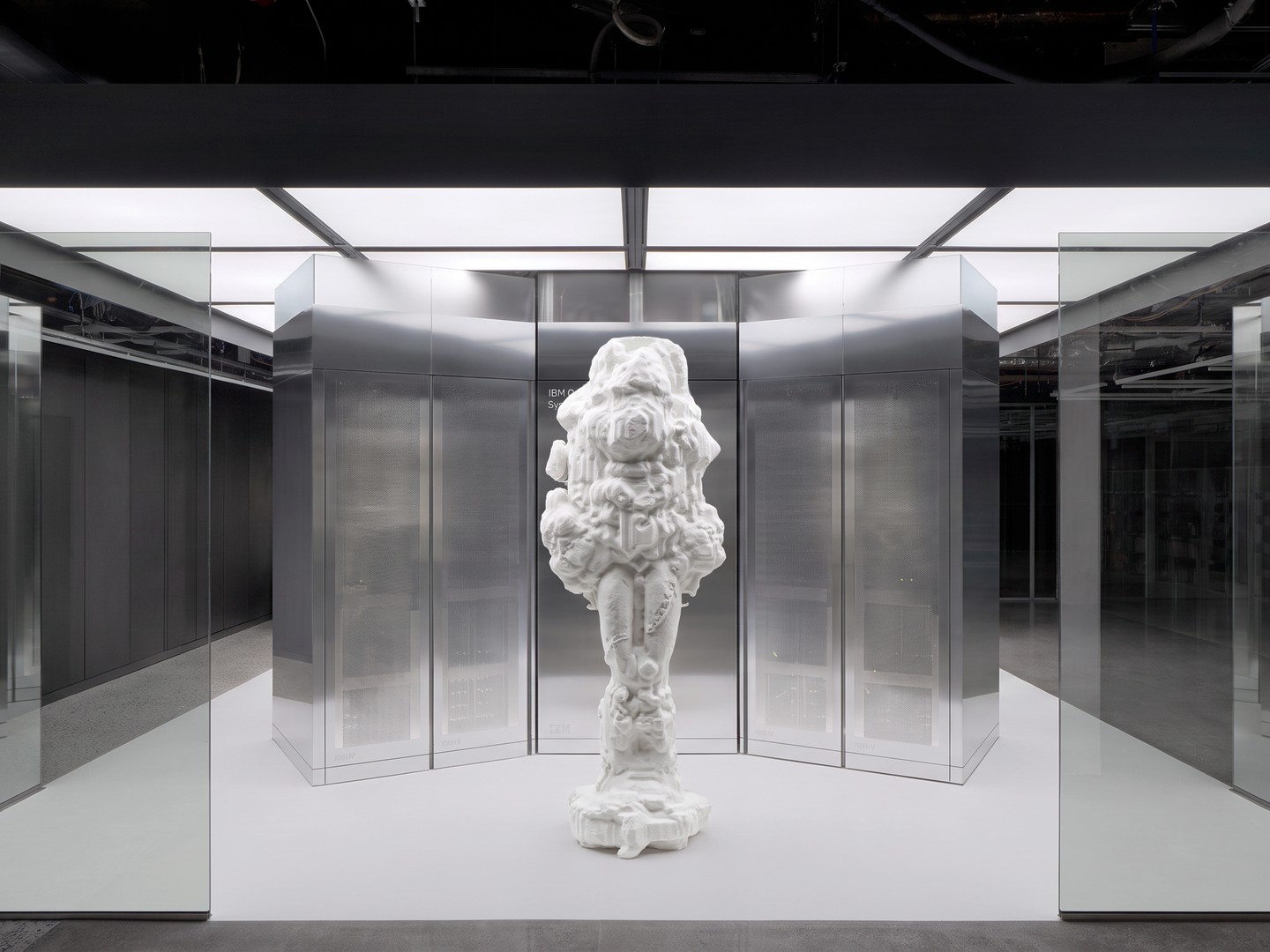
This is a research project developed under Wedge (a design duo of Peiyan Zou & Ray Zhang) using the Moth Quantum API as part of the Moth Hack 2026.
Live demo · Research page · GitHub repo
Abstract
Quantum Sculptor is software that reshapes an existing 3D model using the results of quantum measurement. We take a scan of a statue, divide it into twelve regions we call nations, and give each nation a qubit. On each of sixty turns, every nation is asked one question. A simulated quantum state sets the odds of each answer, and a random number measured on a real IBM quantum processor picks the answer. The answer decides whether the nation adds material to the statue or carves some away.
We argue that measurement does not remove the author. It moves the author's work earlier, into five decisions made before any measurement: the model, how it is divided, the metaphor of nations at war, the rules, and the turn at which to stop. Each run is a space of possible histories far too large to see in full, and each print records one history that never happened to the statue but could have.
We say which parts are measured on hardware, which are simulated, and which we wrote. We take up the strongest objection, that ordinary pseudo-random numbers would make sculptures nobody could tell apart from ours, and close with a caution about our own software, which makes these spaces look easier to see as a whole than they are.
Keywords: latent space, authorship, quantum measurement, counterfactual, generative design, provenance
I. Conditional Authorship
Who is the author of a sculpture when nobody makes the cuts? Not nobody. Measurement moves authorship from the carving to the conditions, and the people who set the conditions are still its authors. A few terms first.
A 3D model describes an object's surface as many small flat triangles; ours began as a scan of a statue. A voxel is a tiny cube, the 3D equivalent of a pixel. Filling the space the statue occupies with a grid of voxels turns it into a block of cubes a program can count and change. A qubit is the basic unit of a quantum computer. An ordinary bit is either 0 or 1. A qubit, until it is measured, holds odds of each, and measuring it gives one definite answer, picked by chance according to those odds.
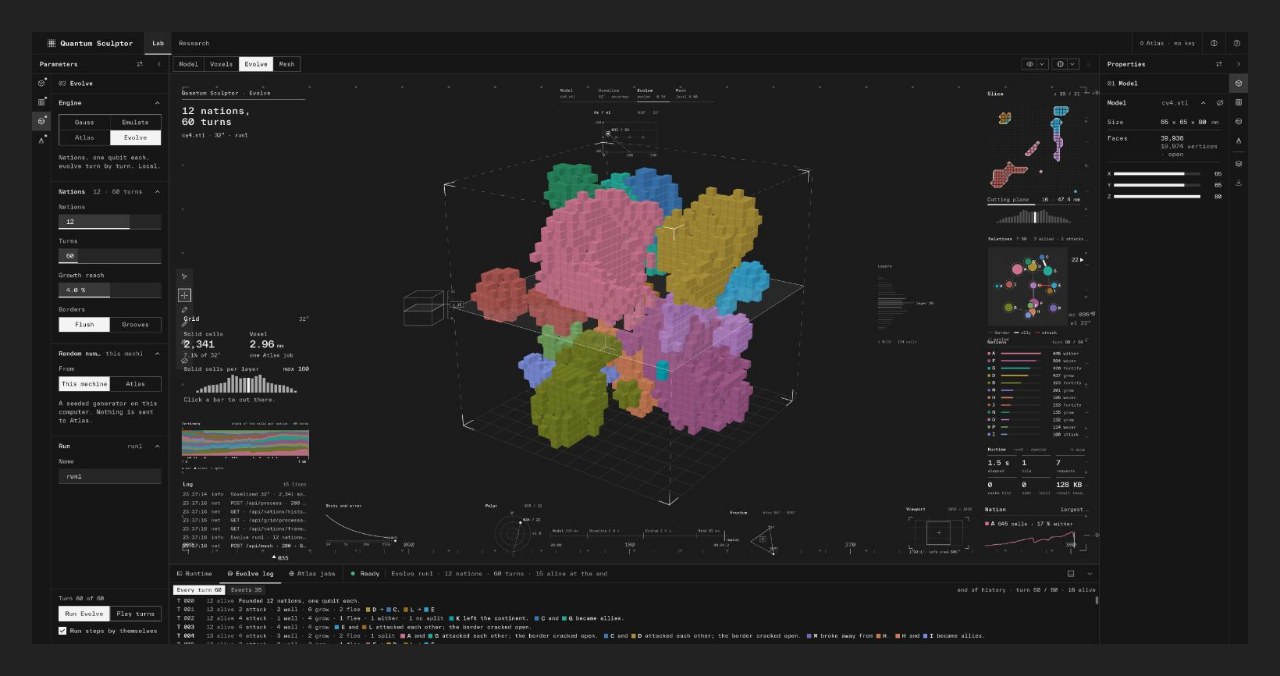
Quantum Sculptor turns a 3D model into voxels, divides the voxels into regions called nations, and lets measurement decide what each nation does on every turn: where material is added and where it is carved away. No person makes those decisions. By the conditions we mean the five things we set before any measurement: the model, how it is divided, the metaphor of nations at war, the rules, and the turn at which to stop. Kate Crawford calls such settings "the parameters of the possible" (Crawford, cited in Somaini, 2026). Measurement chooses only within them.
Each run is therefore a space of possible histories. We can run any named history, but we can never look at all of them. The print is one history made solid: a counterfactual record of the statue, an account of something that did not happen to it but could have, under conditions we can state.
Marshall McLuhan calls every technology an extension of the body that also numbs the part it replaces (McLuhan, 1964, pp. 41-42). Here the hand is what gets replaced: measurement decides where and how much to carve. But measurement is only one of three sources of chance in this work. The other two are rules we wrote, and a quantum state that, for now, we simulate on an ordinary computer. Section II says exactly which is which.
II. Hardware and simulation
Only one part of Quantum Sculptor runs on quantum hardware: the random numbers that decide each answer in Evolve. Everything else is quantum mathematics computed on ordinary computers, or rules we wrote. We set this out first because "quantum" carries an authority that the rest of the paper should not borrow without saying so.
A quantum circuit is a set of instructions; a quantum processor is one machine that can carry them out. For circuits as small as ours, an ordinary computer can follow the same instructions exactly. The state of n qubits is a list of 2ⁿ numbers, and each operation changes that list by a fixed formula. Fifteen qubits are 32,768 numbers, which a laptop handles at once. A real processor does something else: it runs the circuit as a physical experiment, measures it thousands of times, and estimates the odds from the counts, with noise. A simulator gives the exact answer an ideal quantum computer would give. A processor gives a measured one.
Table 1. Where each part of a run comes from.
| Part of the run | Where it comes from |
|---|---|
| Quantum Blur (Atlas engine) | Simulated on Moth's platform. The blur-core-v1 engine runs on a classical statevector simulator, not a quantum processor. |
| Nations' quantum state (Evolve) | Simulated on our computer, one qubit per nation, sixteen at most. It sets the odds of every answer. |
| Random numbers (Evolve) | Measured on the IBM processor ibm_fez, using 5 s of its time, through Moth's random-number engine comet-qrng-v1 |
| Division into nations | Drawn with those measured numbers: voxels grouped by position |
| Question for each nation | Drawn with those measured numbers, weighted by each nation's tendencies |
| Each answer | Both: the odds come from the simulated state, the choice from a measured number |
| Actions, updates, ties | Written: our rules (Section IV) |
| The nations' circuit on a quantum chip | Not yet run. The route exists, as graph-v1 on Atlas |
The random-number engine does not measure our nations. On the IBM processor it prepares a row of Moth's own qubits in an even superposition, measures them, estimates how much randomness the results contain, and returns that randomness as bytes. Our software then uses each byte to settle an answer whose odds it has already computed. If a nation has a 70% chance of a yes and the next measured number is 0.42, the answer is yes. The chip knows nothing about the statue. What it contributes is chance that is physical rather than computed.
So when this paper says "measurement decides," it means this: within odds that follow the rules of a quantum circuit, a number measured on a quantum processor picks the outcome.
III. Information loss
Between the statue and the qubits, information is lost at every step. The statue is scanned. The scan, a surface of 500,112 triangles, is voxelized into a grid of 128 × 128 × 128, of which 39,816 voxels are solid. Regions of that grid are each given a qubit; the qubits are measured; the result reshapes the scanned surface; and the surface is printed (Fig. 1).
Antonio Somaini describes two losses an image goes through on its way into a generative AI model: one when it is digitized, and another when it is compressed into the long lists of numbers, called vectors, that such models work with (Somaini, 2026). Both happen here. The first is the scan and the grid: each voxel records only how much of it the statue fills, so every detail smaller than a voxel is gone. The second is the step onto qubits. In Evolve, a region of about 3,300 voxels is reduced to a single qubit, and all the program knows of that region's character is three numbers.1
The third loss
Measurement is a third loss, and the only step that also gives something back. A nation starts as a region with voxels of its own: definite, countable, in one place. Once it is represented by a qubit, it holds odds instead of an answer. Its qubit is then entangled with its neighbors', linked so that their answers are correlated. The more strongly a nation is linked, the less definite it is on its own: its answers drift toward a coin toss, and only the pair is definite.
Twelve linked qubits are described by 4,096 numbers, one for every combination of twelve answers, and none of those numbers belongs to a single nation. Somaini describes the hidden spaces inside AI models as fields of potential forms rather than stores of finished ones (Somaini, 2026). Between preparation and measurement, a run is such a field almost literally: a list of numbers transformed by matrices, which in our case an ordinary computer holds and transforms.
Measurement keeps one answer out of those odds and discards the rest. It also makes the nation definite again, since a yes or a no becomes a change of whole voxels. But the nation that comes back has shifted its tendencies, strengthened or broken its links, and moved its border (Fig. 2).
A single voxel goes through the same passage in our other engine, the blur. It starts inside or outside the model, becomes a fraction when the model is voxelized, is mixed with its neighbors, and becomes inside or outside again only when the surface is cut at a chosen level, not always on the side where it began. The blur has no randomness of its own: computed exactly, the same model and settings always give the same result. Its strangeness comes from interference, not chance. Numbers in a quantum state can be negative, so they cancel in some cells and pile up in others, opening voids and ridges an ordinary blur cannot make.
IV. The nations-at-war metaphor
The regions are nations at war because the metaphor decides what measurement can do. George Lakoff and Mark Johnson show that metaphors such as ARGUMENT IS WAR shape what people do, not only what they say: we attack a position, defend a claim, and win or lose a point (Lakoff and Johnson, 1980, p. 4). Evolve takes such a metaphor literally. Following a method by the physicist James Wootton for generating maps with qubits (Wootton, 2020),2 its regions are nations, their voxels are territory, and the only verbs open to them are attack, defend and explore. Whatever the measurements decide, they choose among those verbs.
Attack, defend and explore
Each nation is one qubit, and the qubit stores three tendencies: to attack, to defend and to explore. Physicists picture a qubit's state as an arrow from the center of a sphere, and the three tendencies are how far that arrow points along three directions (Fig. 3). With only one arrow, a nation that leans fully toward attack has no lean left for the other two.
The three questions cannot be asked at once, because in quantum mechanics measuring along one direction disturbs the answers along the other two. So the program asks each nation one question per turn.3 Before the answer is settled, only the chance of a yes is known. It depends on how far the arrow points along the direction asked about, a number b between -1 and 1: the chance of a yes is (1 + b) / 2.
Neighboring nations are entangled, and the closer two nations are, the stronger the link the program makes between their qubits.4 Looked at alone, a strongly linked nation is less sure of itself: its arrow shortens and its chance of a yes slides toward one half. Looked at as a pair, the two answers agree more often than chance would give. A nation cannot be strongly linked to all its neighbors at once, a limit of entanglement itself, and that limit is why each nation keeps only one strong tie at a time. Physics suggests the rule; our code enforces it.5
Six marks
On every turn, all nations are set up, asked, settled and moved at the same time (Fig. 4). The question and the answer together decide what a nation does, and each of the six possible actions leaves its own kind of mark on the shape (Table 2). Afterward, tendencies and ties shift by rules we wrote: losing territory makes a nation more inclined to attack, gaining it makes it more inclined to defend, and a fight weakens a tie.
Table 2. The six actions.6
| Asked | Answers yes | Answers no |
|---|---|---|
| Attack | Attack. Takes the outer layer of its least friendly neighbor where the two touch. When two nations attack each other, both front lines vanish and a crack opens between them. | Flee. Breaks contact with that neighbor and moves one voxel outward, until it becomes an island drifting away from the body. |
| Defend | Fortify. Builds up a layer on its outer surface near its borders. | Split. Its far half breaks away and becomes a new nation. |
| Explore | Grow. Fills the gaps inside its own body, then grows outward. | Wither. Its outermost voxels fall away. When none are left, it has died out. |
Metaphoric Design
The cracks, walls, horns and islands in our print are marks of the metaphor as much as of measurement. Under a metaphor of growth, a nation could only add material or shed it, and the form would swell and thin without ever cracking along a front. Under a metaphor of conversation, neighbors would trade voxels across their borders, blurring the borders that war breaks open. The same random numbers, the same twelve qubits and the same sixty turns would carve a different statue in each case. Choosing war was our decision, made before any measurement, and it is the largest single decision in the piece.
V. Experiment Log
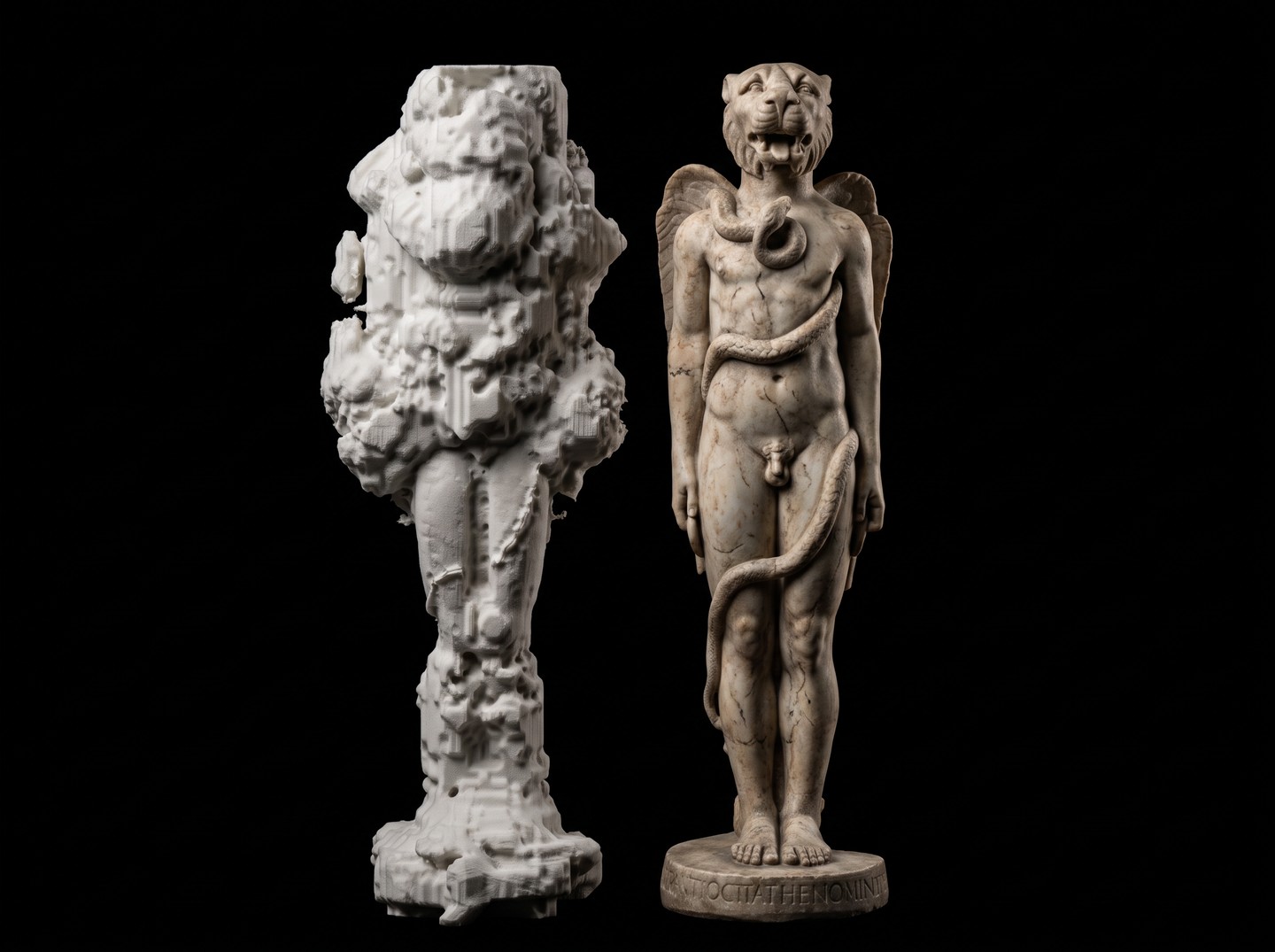
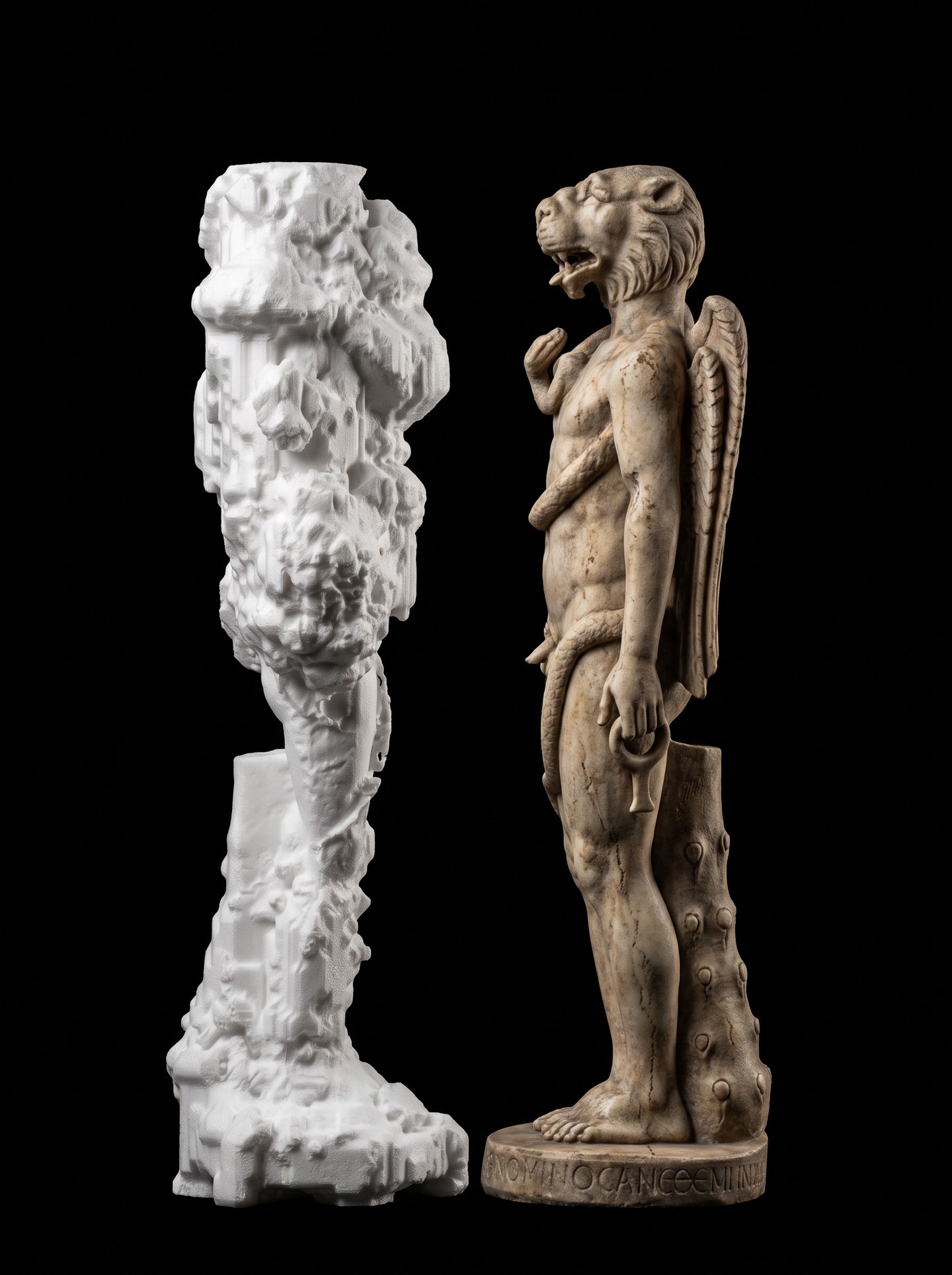
The piece made on 5 October 2026 started from a 3D scan of a Roman statue of Aion, the god of unbounded time, in the Louvre. Table 3 lists every setting of the run. Each one is a decision of ours.
Table 3. Settings of the Aion run.
| Step | Setting | Value | What it decides |
|---|---|---|---|
| Giving the form | Model | Aion_Louvre, 500,112 triangles | The starting point: a scan of a statue |
| Voxel grid | 128³, 39,816 solid voxels | The grain of the material, and the first loss | |
| Evolving | Nations | 12 | 12 qubits, one per region |
| Turns | 60 | 60 rounds of answers, and where the history stops | |
| Reach | 4% of the grid | How far walls and horns may stand out from the original surface | |
| Random numbers | ibm_fez, 5 s | A real IBM quantum processor and the time used on it | |
| Joining | Surface | Quantum field | Keep the original surface, then let the result push it |
| Push amount | 6 (range 0 to 8) | How far the result moves the original surface | |
| Threshold | 0.18 | Where the surface is cut; lower swells the form, higher erodes it | |
| Refinement | ×2, 256³ | How much of the scan's fine detail survives the first loss | |
| Finishing | Cleanup | Close 1.5, smooth ×19 | Small gaps closed, surface smoothed, all large pieces kept |
| Print height | 90 mm | The size of the object |
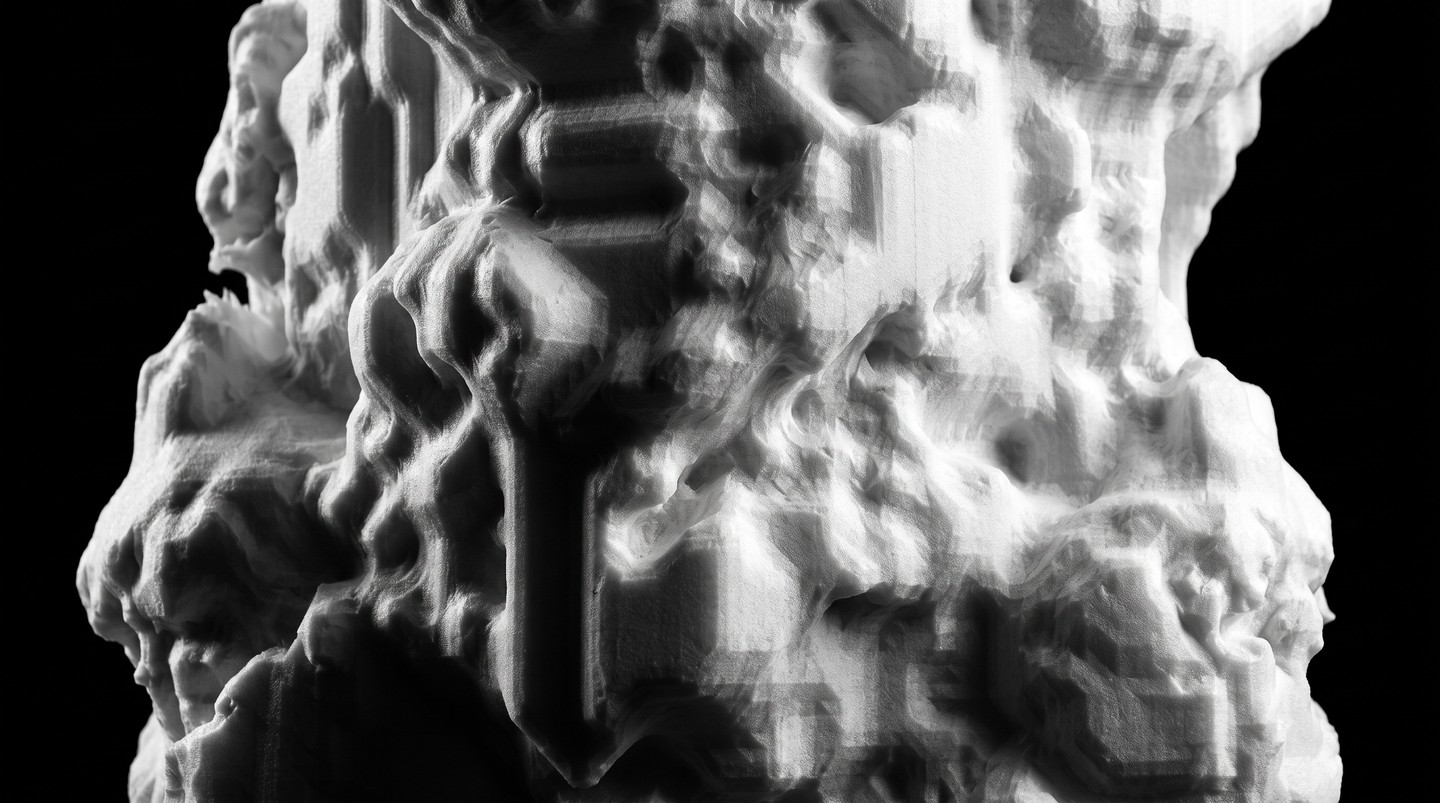
Over the sixty turns, the twelve nations became sixteen through four splits, and all sixteen survived. Twice, two nations attacked each other at once, opening cracks. One nation fled off the body. None was absorbed by a neighbor or died out. The number of solid voxels went from 39,816 to 53,196: 22,784 were added and 9,404 carved away.
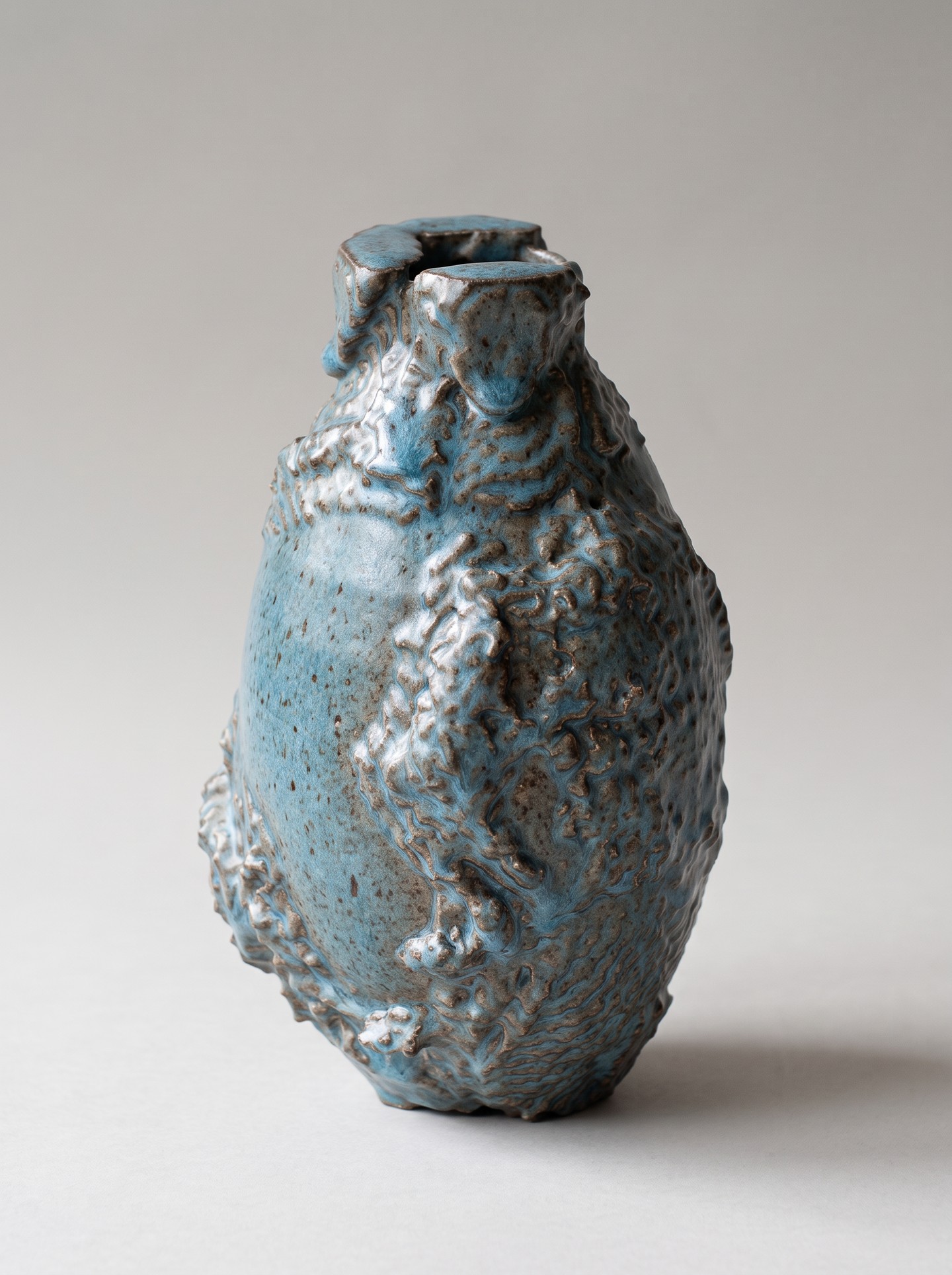
The evolved grid is too coarse to print on its own and knows nothing of the scan's fine surface. So we kept that surface, rebuilt it on a finer grid of 256 × 256 × 256 voxels, and let the evolved result push it: outward where nations grew, inward where material was carved away. How far it moves is the push amount (Fig. 5). At 0 the scan comes back unchanged; at 8 the form is as close as possible to what the nations made on their own. We chose 6. At 6 the statue is still recognizable, while its body breaks into sections, walls rise along the borders, horns grow from the surface and islands drift away from it (Figs 6 to 8).
To stop somewhere
A history has no natural end. Under an earlier version of the rules we let one run go on for 400 turns, and at the end about a hundred voxels were still changing hands every turn. Sixty turns is the software's default, and we kept it. Any other number would have given a different object from the same random numbers, since a shorter run is exactly the beginning of a longer one. Stopping is as much a decision as the model or the metaphor, made before the first measurement.
VI. Quantum randomness and pseudo-random
A skeptical reader will say this is a random-number generator with a quantum label. Ordinary computers make random numbers with a formula, a pseudo-random generator, whose output looks random but is fixed entirely by a starting value. Seed one with a number we typed, run the same rules, and the sculptures would be indistinguishable from ours.
On what the form looks like, the objection is right, and Section II already concedes most of it. The odds come from a simulated state, and the rules are ours. Our own figures agree. Under an earlier version of the rules, nations linked as allies acted together 60% of the time, against 54% when each tossed its own coin.7 The quantum correlations leave a small trace in the shape, and the rules leave most of it. We have not repeated that measurement under the current rules.
McLuhan's "the medium is the message" (McLuhan, 1964, p. 7) says that the means by which something arrives matters more than what it carries. That is where the difference lies. The form may be the same; the object is not. Every decision in our print traces back to a named quantum processor, a measured amount of time on it, and a count of the random bytes that arrived and were used.8 All of it is written into the provenance record saved beside the printable file.
A pseudo-random version would trace back to a number we typed, and its record would say so. Ours traces back to ibm_fez and five seconds of processor time. The record also states its limits: a simulated state, a small trace of correlation, and a circuit not yet sent to a chip.
One limit sits outside our record. The hardware run went through Moth's account with IBM, so the only independent proof that those bytes came from ibm_fez is IBM's own job log, which Moth holds. The engine also reports a Bell test, which shows the chip's qubits were entangled. By the engine's own description, that is a check on the device, not a proof of where each byte came from. Confirming the job records with Moth is our next step.
VII. Latent space
What is a run, before it is printed? We think it works like the latent space of an AI model. In machine learning, a latent space is the internal space in which a model represents what it has learned. Each example, an image for instance, is compressed into a short list of numbers and placed as a point in that space. To generate something new is to move through the space and turn the point one arrives at back into an image. Somaini argues that images today cannot be understood without understanding these spaces (Somaini, 2026).
A run has the same parts on a small scale. Voxelizing compresses the model. Giving each nation a qubit reduces it to a few numbers. Between preparation and measurement there are only odds, spread over every history the rules allow.
That spread is far too large to look at. On each turn, twelve nations can each be asked one of three questions and give one of two answers: 6¹², about 2.2 billion combinations for a single turn, before any split adds a thirteenth nation. Over sixty turns that grows to more than 10⁵⁶⁰ possible histories for one run. A run's name fixes the starting point of its random choices, so the same name always leads back to the same history.9 We can run any named history, but we can never look at all the possible ones.
Wolfgang Ernst calls this kind of collection a "latent archive," made of "algorithmic objects" that "always come into being anew" instead of existing as fixed data (Ernst, 2013, p. 82). Our runs are kept as names and records. The form itself is not stored anywhere; it comes into being again whenever a name is run. On 5 October we made three runs, and their random numbers were measured on three IBM processors: ibm_marrakesh, ibm_boston and ibm_fez (Fig. 9).
Somaini also insists there is no single latent space: each model compresses different data and builds its own selective statistical world (Somaini, 2026). Our three runs are a small case of that plurality. Same statue, same rules, three sources of measured chance: three different forms.
A counterfactual record
Where analysis asks what happened, Somaini writes, generative models produce "what could have happened, given the conditions that the models have captured and encoded during training" (Somaini, 2026). Our print is an object of this kind. The scan records a statue that exists. The sixty turns record a history that never happened to it but could have, given its shape, its division into twelve and the six actions open to its parts. The reshaped surface holds both in one skin: its fine detail comes from the scan, its walls and cracks from odds and rules, and nothing on the object marks where one stops and the other begins.
The three runs could be averaged into one form. Hito Steyerl argues that generative AI makes "mean images," renderings of a statistical average that belong to no actual case (Steyerl, 2023). An average of our runs would be that kind of form: no closer to the statue and no more correct than any one of the three, and the product of no history at all. We keep the runs side by side instead, each filed under its name.
VIII. Limitations
The Lab, the interactive part of Quantum Sculptor, presents runs as if they could be seen as a whole. It is a 3D workspace in which every run of a session is filed under its name, one timeline scrubs back and forth through a history, and every readout around the object shows the same moment (Figs 10 to 12). Roland Meyer calls the promise built into such tools, that a user can see and control a whole collection, an "operative imaginary," made of "the ideas of overview, access, and control" (Meyer, 2025, p. 276). The Lab shows three runs side by side, smoothly, as if they were a fair sample of the space. They are three paths out of more than 10⁵⁶⁰.
Anthony Downey, discussing Trevor Paglen's AI-generated series Adversarially Evolved Hallucinations, describes how such images invite us to take a machine's guess for a record of the world: a projection from probabilities, made by a process we cannot inspect (Downey, 2024). Our forms invite the same over-reading, and the word "quantum" adds an authority of its own. A print is one guess under stated conditions.
The software works against its own promise by keeping those conditions in view: the odds before every answer, the engine that produced a result, whether that engine was simulated or measured, the processor the random numbers came from and how many were used, and the word "preview" wherever a value is assumed rather than computed. The record saved with every export carries the same list.
IX. Further Investigations
We made three runs on 5 October 2026 and printed the one whose random numbers were measured on ibm_fez. The runs measured on ibm_marrakesh and ibm_boston are named, so either could be run again, reshaped and printed. Leaving them unprinted was a decision of the same kind as stopping at turn sixty, and the object on the table does not show it.
Two next steps follow from Section II. The nations' circuit can be sent to a quantum processor as it stands, through Moth's graph-v1 engine; real hardware will add noise to every answer, and we do not yet know whether that noise leaves a visible mark. The blur can be compared the same way: the simulated result against the same circuit run on a chip.
Notes
-
Quantum Blur reduces the grid differently: seven qubits hold a row of 128 voxels as 128 numbers, and each added qubit doubles the length. On Atlas a large grid is split into tiles, each sent as its own job. ↩
-
Wootton treats the regions of a map as nations with one qubit each. Here the map is a body, and the regions are found by grouping the solid voxels by position. ↩
-
The three tendencies are the X, Y and Z components of one qubit's state. Measuring along one axis leaves the other two undetermined. To ask a question, the program first turns the asked axis onto the one it measures. b is the component of the qubit's actual state along that axis, which is shorter than the direction it was given whenever the qubit is entangled. ↩
-
The link is a two-qubit operation, a ZZ rotation, with angle θ = s · π / 2, where s, the strength of the tie, runs from 0 to 1. ↩
-
We tested the alternative. When every tie could tighten at once, the agreement within any one pair was washed out by the others, and nations acted like independent coin tosses. Only a few exclusive ties let allies act together, so we wrote that limit into the rules. ↩
-
A defending neighbor holds against one attacker and gives way to two attacking in the same turn. A neighbor with too little left is absorbed whole. Only a nation that has grown past its starting size can split. ↩
-
The rules have changed since that measurement, most of all in how ties are kept. The figures are an indication, not a result for this piece. ↩
-
The random bytes that arrived and the bytes used are counted in the record saved beside the printable file. ↩
-
In Evolve the run name sets the starting point of the random choices: the same name gives the same history, and a shorter run is exactly the beginning of a longer one. ↩
References
- Downey, A. (2024) 'Uncanny returns: Trevor Paglen and the hallucinatory domain of generative AI', The MIT Press Reader, 23 September. Available at: thereader.mitpress.mit.edu (Accessed: 6 October 2026).
- Ernst, W. (2013) 'Underway to the dual system: classical archives and digital memory', in Parikka, J. (ed.) Digital memory and the archive. Minneapolis: University of Minnesota Press, pp. 81-94.
- Lakoff, G. and Johnson, M. (1980) Metaphors we live by. Chicago: University of Chicago Press.
- McLuhan, M. (1964) Understanding media: the extensions of man. New York: McGraw-Hill.
- Meyer, R. (2025) 'Operative image spaces: navigating virtual museum collections', Swiss Journal of Sociology, 51(2), pp. 273-289. doi:10.26034/cm.sjs.2025.6926.
- Somaini, A. (2026) 'Latent spaces: AI, art, and the archive', October, 196, pp. 19-60. doi:10.1162/octo.a.545.
- Steyerl, H. (2023) 'Mean images', New Left Review, 140/141, pp. 82-97. Available at: newleftreview.org (Accessed: 6 October 2026).
- Wootton, J.R. (2020) 'A quantum procedure for map generation', in 2020 IEEE Conference on Games (CoG). Osaka, 24-27 August. IEEE, pp. 73-80. doi:10.1109/CoG47356.2020.9231571.
Sources: IBM Quantum processors ibm_fez, ibm_marrakesh and ibm_boston; Moth Atlas and its engines comet-qrng-v1 (random numbers, on IBM hardware), blur-core-v1 (Quantum Blur Core, on a classical simulator) and entanglement-shader-v1 (display shading only), Moth Quantum documentation; source code at wedgeglobal/Quantum-Sculptor.